
What Is NB-IoT?
Narrowband IoT (NB-IoT) is a standard-based low-power wide area network (LPWAN) technology that connects a vast number of IoT devices and services while utilizing existing cellular bands.

History of Narrowband IoT and LPWAN
NB-IoT was born out of the need for a more efficient and cost-effective way to connect IoT devices. Advanced Metering Infrastructure (AMI) has been a key player in the evolution of NB-IoT technology especially in smart grid initiatives. Originally developed by 3GPP (3rd Generation Partnership Project), it uses existing LTE infrastructure and is optimized for low data rates and power consumption. Its history can be traced back to early M2M (Machine-to-Machine) communication, which grew into standardized technology that can support hundreds of devices per square kilometer.
What is NB-IoT Used For?
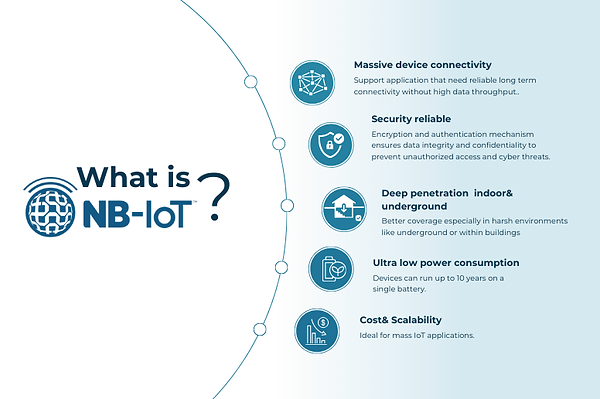
NB-IoT is important in the IoT ecosystem because it has the capability to support massive device connectivity with minimal power consumption and wide coverage. It fills the gap for applications that need reliable long-term connectivity without high data throughput, thus enabling many innovative IoT solutions. NB-IoT also enables energy efficiency by providing granular energy consumption insights so businesses can make better decisions on energy usage.
NB-IoT Architecture and Protocols
NB-IoT’s architecture consists of the device itself, the base station, and the core network. Devices communicate with base stations which then route the data to the core network where it is processed and managed. The protocols used are optimized for small data packets to ensure efficient and reliable data transmission even in harsh environments.
What are examples of NB-IoT devices?
1. Smart meters
Smart meters are NB IoT devices commonly used by utilities. Meters would send small, frequent updates about usage and system status through NB-IoT connectivity.
2. Environmental sensors
This device is usually found in the agriculture industry and integrated with narrowband IoT network. Its ability to track soil moisture, temperature, and many others makes it an ideal choice for agriculture.
With these use cases NB-IoT provide connectivity in remote or hard-to-reach areas where other technologies fail, making it a good solution for mass IoT applications. NB-IoT has many benefits like low power consumption, wide area coverage, and the ability to connect to many devices.
NB-IoT Deployment Options
NB-IoT operates in a 200 kHz narrow bandwidth and can be deployed in three modes: standalone, in-band, and guard-band. Standalone uses unused spectrum, in-band shares spectrum with LTE and guard-band uses the guard bands of LTE channels. In rural or remote areas, standalone deployment can be used to utilize any available spectrum for wider coverage. This flexibility allows it to be integrated into existing cellular networks with minimal interference.
Notably, the world’s first standalone private NB-IoT network, launched in Florida last month, operates using the upper 700 MHz A-Block spectrum. This spectrum plays an important role in supporting infrastructures and utility applications, and Ubiik NB IoT solutions supports this NB-IoT frequency band.
Benefits of NB-IoT

1. Better Coverage and Penetration
NB-IoT’s coverage is one of the best one among other technologies, especially in harsh environments like underground or within buildings. Its signal penetration is better than traditional cellular technologies. This is perfect for smart meter deployment to ensure reliable connectivity and efficient power management in many scenarios.
2. Low Power for IoT Devices
NB-IoT is designed for ultra-low power consumption, devices can run up to 10 years on a single battery. This is achieved through power-saving features like extended discontinuous reception (eDRX) and power saving mode (PSM).
3. Cost and Scalability
With the ability to support hundreds of devices per base station and lower deployment costs, NB-IoT is cost-effective and scalable. This makes it ideal for mass IoT applications.
NB-IoT and Its Applications Across Industries

1. Smart Cities, Urban Infrastructure, Smart Metering
NB-IoT is key to smart cities by enabling applications like smart street lighting, waste management and intelligent parking. Electricity meters track utility energy consumption so businesses can make better energy decisions. These solutions optimize urban infrastructure and improve the lives of citizens.
2. Environmental Monitoring and Agriculture
In agriculture, NB-IoT enables remote monitoring of soil moisture, weather and livestock tracking. Utility meters monitor environmental conditions and resource usage. Environmental monitoring applications include air quality sensors and water quality monitoring to protect natural resources.
3. Healthcare and Remote Patient Monitoring
NB-IoT supports remote patient monitoring devices to track health continuously and reduce hospital visits. Medical devices with NB-IoT enable health tracking to improve patient care. This is ideal for chronic disease management and elderly care.
What is the difference between LTE and NB-IoT?
NB-IoT and LTE-M are the leading LPWAN technologies, each with their own strengths. NB-IoT offers better coverage and penetration, while LTE-M provides higher data rates and lower latency. A comparison can help determine which technology is best suited for your use case.
Security and Privacy in NB-IoT
In the world of narrowband internet of things, Encryption and authentication mechanisms ensure data integrity and confidentiality to prevent unauthorized access and cyber threats. With its strong security measures and continuous update NB-IoT are prepared to go against emerging threats. This process involves carefully managing device authentication, securing data transmission channels, and regularly auditing systems to ensure they remain secure against potential vulnerabilities.
Challenges in NB-IoT
1. Data Transmission and Security
NB-IoT is designed for small data packets so it’s not suitable for applications that require high data throughput. This can be a problem for scenarios where large amounts of data need to be transmitted quickly or continuously. Mismanagement of network resources in such scenarios can lead to security vulnerabilities and service disruptions that can compromise the integrity and performance of these resources.
2. Roaming
NB-IoT is designed for ultra-low power consumption, devices can run up to 10 years on a single battery. This is achieved through power-saving features like extended discontinuous reception (eDRX) and power saving mode (PSM).
3. IoT Device Mobility
NB-IoT is suitable for stationary or low-mobility applications. When devices are in motion, maintaining a connection becomes a problem as the technology can’t handle frequent cell handovers well. This can cause service disruptions for mobile applications.
4. Integration with Legacy Systems
Integrating NB-IoT with existing legacy systems is complex. It requires thorough planning and sometimes requires upgrading or modifying existing infrastructure to support new connectivity.
Summary
NB-IoT is becoming a critical technology for digital transformation across industries. Integrating with legacy systems is hard but the benefits – wide coverage and energy efficiency – make it a good solution for IoT projects. As technology evolves NB-IoT will play an even bigger role in IoT solutions, so it’s going to be part of the future IoT landscape.